
The Augmented Enterprise
An Augmentation-Driven Organizational Redesign (ADOR) Framework for Human–Algorithm Interaction in the Age of Generative AI
Author: Sheeba Chandini
SheebaChandini LLC & Global Care Initiative
Conference Poster Presentation | 2026
Executive Summary
The rapid integration of Generative AI (GenAI) marks a structural shift in enterprise capability—from optimization and reporting toward novel decision generation and autonomous action. While this transition unlocks unprecedented value across sectors—from semiconductor R&D and biotech compliance to design innovation and education—it also introduces systemic risks: human skill atrophy, misplaced trust in algorithmic outputs, and governance gaps in high-stakes environments.
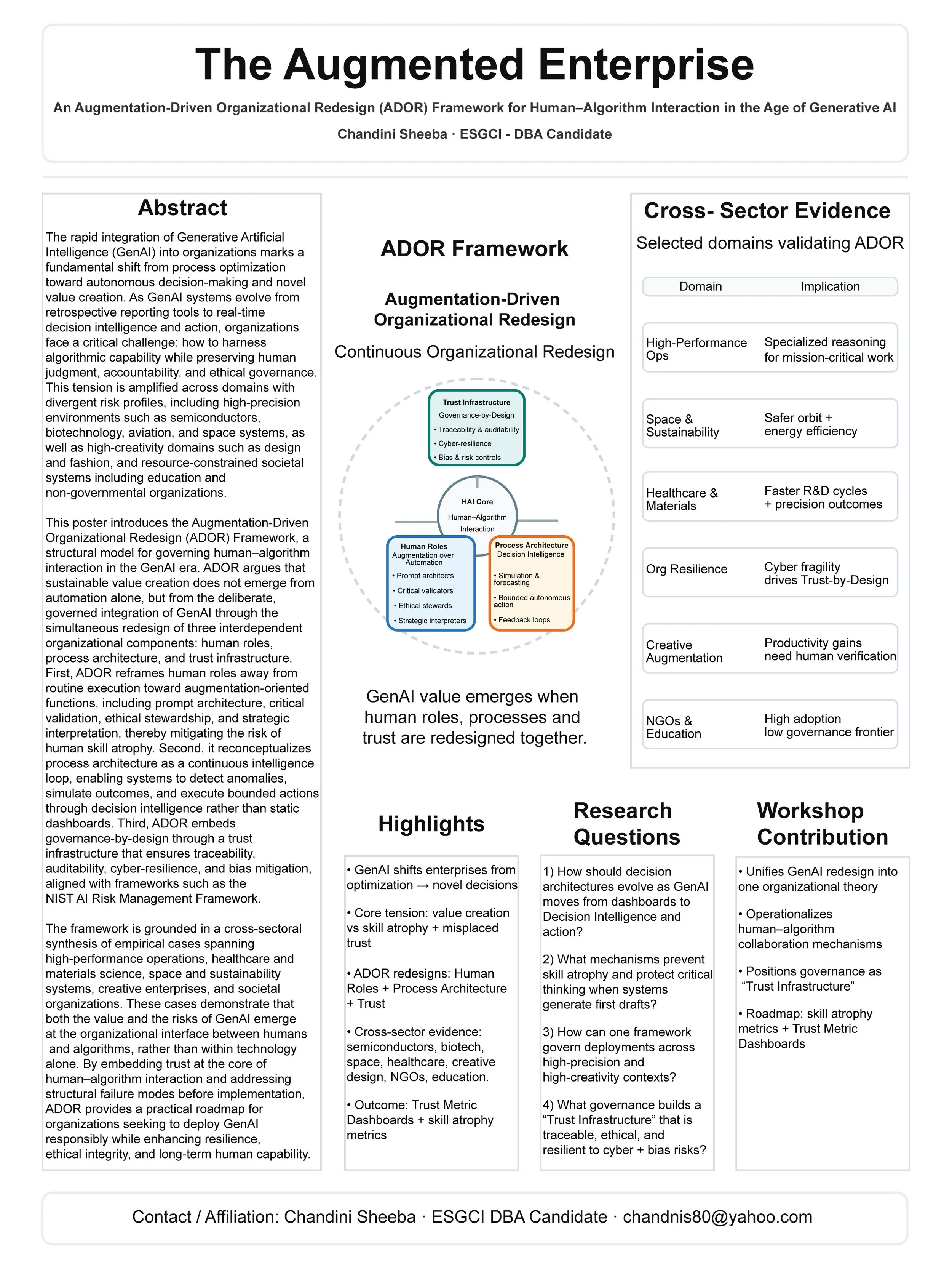
This research introduces the Augmentation-Driven Organizational Redesign (ADOR) Framework, a unifying model for designing human–algorithm collaboration that preserves human judgment, safeguards critical thinking, and embeds ethical governance as a core enterprise capability. Drawing on a cross-sector, multi-case analysis, the framework offers actionable guidance for enterprises navigating GenAI deployment across high-precision and high-creativity domains.
Research Motivation & Context
Generative AI is no longer a productivity layer—it is becoming an organizational actor.
Across industries, GenAI systems are now:
Generating first-draft decisions, not just insights
Influencing regulatory strategy, R&D pathways, and creative outputs
Operating within environments where errors can carry safety, ethical, or societal consequences
This shift demands a redesign of decision architectures, not just technology stacks. Without intentional organizational design, enterprises risk over-automation, erosion of human expertise, and brittle decision systems.
Research Questions
This study addresses four interrelated questions central to the organizational, strategic, and societal implications of AI:
Decision Architecture Redesign
How should enterprises redesign decision architectures as GenAI evolves from retrospective dashboards to autonomous decision intelligence?Human Skill Preservation
What organizational mechanisms prevent skill atrophy and protect critical thinking when generative systems produce instant, first-draft outputs?Cross-Context Applicability
How can a single framework accommodate GenAI deployment across:High-precision domains (e.g., semiconductors, biotech regulation)
High-creativity domains (e.g., UI/UX, fashion CAD, design innovation)?
Ethical Governance Integration
How can ethical governance be embedded as an operational capability rather than treated as an external compliance function?
Key Contribution: The ADOR Framework
ADOR (Augmentation-Driven Organizational Redesign) reframes GenAI adoption from automation-first to augmentation-first.
Core principles include:
Clear separation between human judgment zones and algorithmic generation zones
Decision checkpoints that require human sensemaking, not just approval
Context-sensitive augmentation strategies for precision vs. creativity-heavy domains
Ethical governance embedded into workflow design, not retrofitted after deployment
The framework is designed to scale across enterprise functions while maintaining resilience, accountability, and human agency.
Cross-Sector Insights (Illustrative Domains)
The framework is informed by cases spanning:
High-stakes operations: Semiconductors, Biotech, Aviation, Space
Creative systems: UI/UX, Fashion CAD, Design Engineering
Societal systems: NGOs, Education, Global Development
Despite functional divergence, consistent patterns emerge around where augmentation succeeds—and where it fails.
Citation (APA):
Chandini, S. (2026). The Augmented Enterprise: An Augmentation-Driven Organizational Redesign (ADOR) Framework for Human–Algorithm Interaction in the Age of Generative AI. Conference Poster Presentation.
(Work in progress — citation details may be updated post-conference.)
About the Author
Sheeba Chandini is Founder and Board Chair of SheebaChandini LLC and Global Care Initiative, working at the intersection of design, enterprise strategy, AI governance, and ethical leadership. With cross-sector experience spanning technology, healthcare, semiconductors, creative industries, and global service, her research focuses on human-centered AI systems, ethical governance, and organizational resilience in the age of intelligent systems.
Connect & Follow Up
📧 Email: sheebachandini@gmail.com
🔗 LinkedIn: https://www.linkedin.com/in/sheebachandini
🌐 Website: https://sheebachandini.com
Interested in:
Framework discussion
Cross-sector collaboration
Follow-up paper or case study access
👉 Feel free to connect or reach out after the session.